Your washer isn’t spinning almost certainly because of one of three things. A safety lock that isn’t confirming closed. A drive belt that’s worn through or snapped. Or an unbalanced load the machine is refusing to spin until corrected.
That’s the short answer. The real answer, the one that actually gets your laundry moving again, comes down to what else your washer is doing alongside the failure to spin. Is it filling normally? Draining completely? Agitating just fine, then stalling at the very last step? Each combination tells a distinctly different story.
Here’s how to read it.
Start Here: Is the Load Genuinely Balanced?
Before touching a single internal part, rule this out first.
Modern washers will not spin at all once a load has shifted heavily to one side of the drum. This isn’t a defect. It’s the machine deliberately protecting itself.
Quick fix:
- Open the washer.
- Redistribute the clothes evenly around the drum.
- Add a towel or two if the load is small and unevenly weighted.
- Restart the spin cycle.
Have you actually tried this yet, or did your mind jump straight to assuming something had broken? A meaningful share of “my washer is broken” calls end right here, with nothing more than a rebalanced load.
The Most Common Real Cause: A Lid or Door Lock Failure
If rebalancing didn’t resolve it, this is very likely your next answer, and honestly, the single most probable one.
Every modern washer demands a confirmed, fully engaged lock before it will spin. This is a genuine safety feature, not an arbitrary inconvenience. A drum spinning at full speed with an unlatched door isn’t just messy. It’s a real hazard.
On top load washers, this component is called the lid switch or lid lock assembly. On front load washers, it’s the door lock, frequently governed by a small part called a wax motor, which physically drives a locking pin into place using heat activated expansion.
Signs this is genuinely your issue:
Repeated clicking as the machine attempts, and fails, to confirm the lock The washer fills and agitates normally but stalls short of spinning On Whirlpool or Maytag models specifically, an F5 E1 or F5 E2 error code displayed directly on the control panel, pointing precisely at this failure.
What’s worth trying yourself
press the lid down firmly and listen for a distinct, confident click before starting the cycle. Silence where that click should be is a strong signal the lock itself has failed and needs replacing.
The Second Most Common Cause: A Worn or Broken Drive Belt
This is the unmistakable “I can hear the motor, but nothing’s actually turning” scenario.
The drive belt is the physical link transferring power from the motor to the drum itself. Once it wears thin, slips loose, or snaps outright, the motor continues running exactly as designed. It simply has nothing left connected to turn.
Telltale signs:
A squealing or high pitched screeching sound during the wash or spin cycle A faint, distinctly unpleasant smell of burning rubber The drum turning weakly, unevenly, or not at all despite an audibly running motor
How to check it yourself:
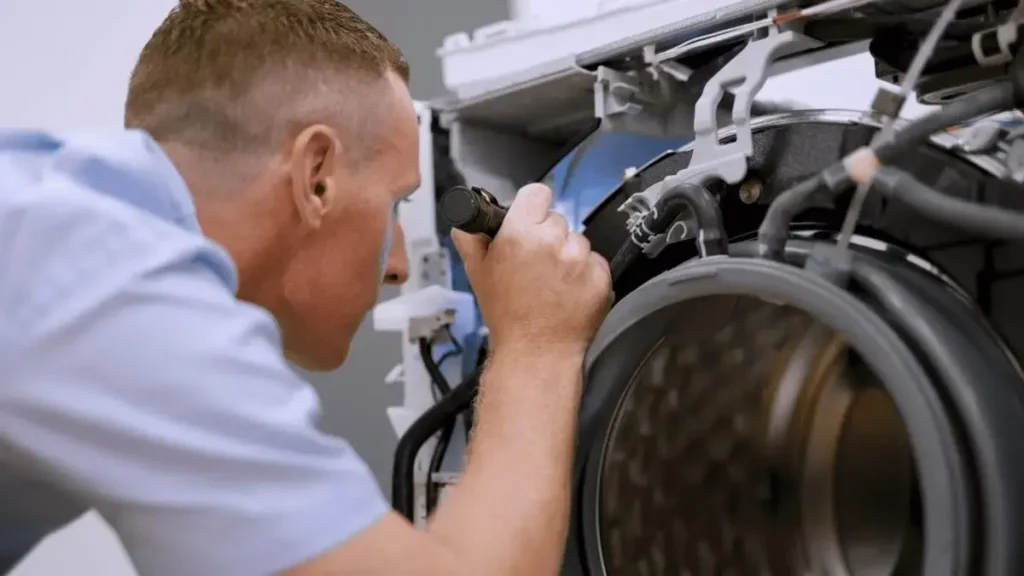
with the washer safely unplugged, most models allow visual inspection of the belt by removing the back or side panel. A belt that’s visibly cracked, sitting loose on its pulleys, or entirely missing confirms the diagnosis immediately.
This is a repair plenty of confident homeowners tackle themselves, though it does require safely accessing the machine’s internals. If that’s not something you’re genuinely comfortable doing, this is a perfectly reasonable one to leave to a technician.
A Less Obvious Cause: The Motor Coupling or Clutch
This particular cause trips people up because the surface symptoms look nearly identical to a belt failure, yet the underlying fix is entirely different.
On certain top load washers, a plastic motor coupling connects the motor directly to the transmission. It’s actually engineered to fail on purpose under excessive strain, specifically to spare the far more expensive motor and transmission from real damage during an overloaded or unbalanced cycle.
A classic signature of this exact failure: the washer fills completely, drains completely, agitates without issue, and then simply refuses to spin at the very final stage.
On other models, a clutch assembly plays a comparable role. As it gradually wears down through ordinary years of use, it begins slipping rather than fully engaging. You’ll often hear a scraping sound quietly building over several weeks before the spin cycle finally gives out entirely.
Neither of these repairs qualifies as a quick weekend fix. Both genuinely require partially disassembling the washer’s cabinet, which is precisely where professional diagnosis earns its cost back in time saved and parts correctly identified.
What Your Washer’s Other Symptoms Are Actually Telling You
Rather than guessing, match what you’re observing against the pattern below.
| What’s Happening | Likely Cause |
|---|---|
| Fills, agitates, stalls before spinning, repeated clicking | Lid or door lock failure |
| Motor audibly running, drum barely moves or stays still | Broken or worn drive belt |
| Fills, drains, agitates normally, zero spin at all | Motor coupling failure |
| Building scraping noise over weeks, then no spin | Worn clutch assembly |
| Door refuses to lock, no click when closed | Door lock or lid switch |
| Error code displayed on the control panel | Consult your model’s specific code guide first |
Have you noticed a gradual pattern building over recent weeks, like a slowly worsening noise, rather than a sudden and complete stop? That timeline alone is a genuinely useful clue. A gradual escalation tends to point toward a wearing part like a clutch. A sudden, total silence points more directly toward an electrical or lock related failure.
A Story Worth Knowing
A homeowner in Overbrook once described her washer filling, agitating, and draining entirely normally, week after week, yet never actually spinning the water back out. Every load came out completely soaked.
She was convinced the motor itself was failing. The actual cause was a worn motor coupling, the small plastic component intentionally designed to fail under strain rather than allow the motor or transmission to absorb the damage instead. Once it was replaced, the washer spun normally again, and the repair cost a genuine fraction of what a new motor would have run.
That’s a worthwhile reminder. A washer that completes every step except spinning is usually communicating something very specific, not signaling a catastrophic, total failure.
When to Stop Troubleshooting and Call a Technician
A handful of signs genuinely mean it’s time to bring in professional help.
- You’ve rebalanced the load and confirmed a fully engaged door lock, and it still won’t spin
- You’re hearing grinding, scraping, or catching a burning smell
- An unfamiliar error code appears that your owner’s manual doesn’t clearly explain
- The washer keeps stopping mid cycle repeatedly, not as a one time occurrence
Preventive Habits That Meaningfully Reduce Spin Failures
Avoid overloading the drum, easily the single biggest contributor to premature coupling and clutch wear
Distribute heavy items like towels and bedding evenly before every cycle begins
Address unusual noises early, rather than waiting until they escalate into a full failure
Never force a resisting lid or door shut. That resistance is frequently an early, honest warning sign
Frequently Asked Questions
Why does my washer fill and drain but not spin?
This specific pattern most often points toward a failed motor coupling or a worn clutch assembly, both of which allow the machine to move through earlier cycle stages normally while failing precisely at the spin stage itself.
Why is my washer clicking but not spinning?
Repeated clicking almost always signals the lid or door lock attempting to engage but failing to confirm a full lock, which prevents the spin cycle from ever starting as a deliberate safety measure.
Can an unbalanced load really stop a washer from spinning entirely?
Yes, genuinely. This is intentional behavior, not a malfunction. Redistributing the load and restarting the cycle resolves this instantly in the vast majority of cases.
Is a broken drive belt expensive to fix?
Not typically. Drive belts themselves are relatively inexpensive components, though labor cost to access them varies meaningfully depending on how a particular washer’s cabinet is designed to open.
What Your Washer’s Symptoms Can Tell You
Most washers that refuse to spin fall into one of four recognizable patterns. An unbalanced load. A failed lock. A worn belt. A failing coupling or clutch. What else is happening throughout the cycle, filling, draining, clicking, or a slowly building noise, remains the fastest, most reliable way to tell them apart.
What to Do When Your Washer Won’t Spin
A washer that won’t spin is rarely an unsolvable mystery. It’s almost always one specific safety feature working exactly as intended, or one specific worn part finally giving out after years of honest, ordinary use.
Start with the simple checks first, an unbalanced load and a fully latched door, before assuming the worst. If those don’t resolve it, the exact pattern of symptoms you’re seeing is usually more than enough to point a technician directly to the true cause, without unnecessary guesswork or wasted cost.